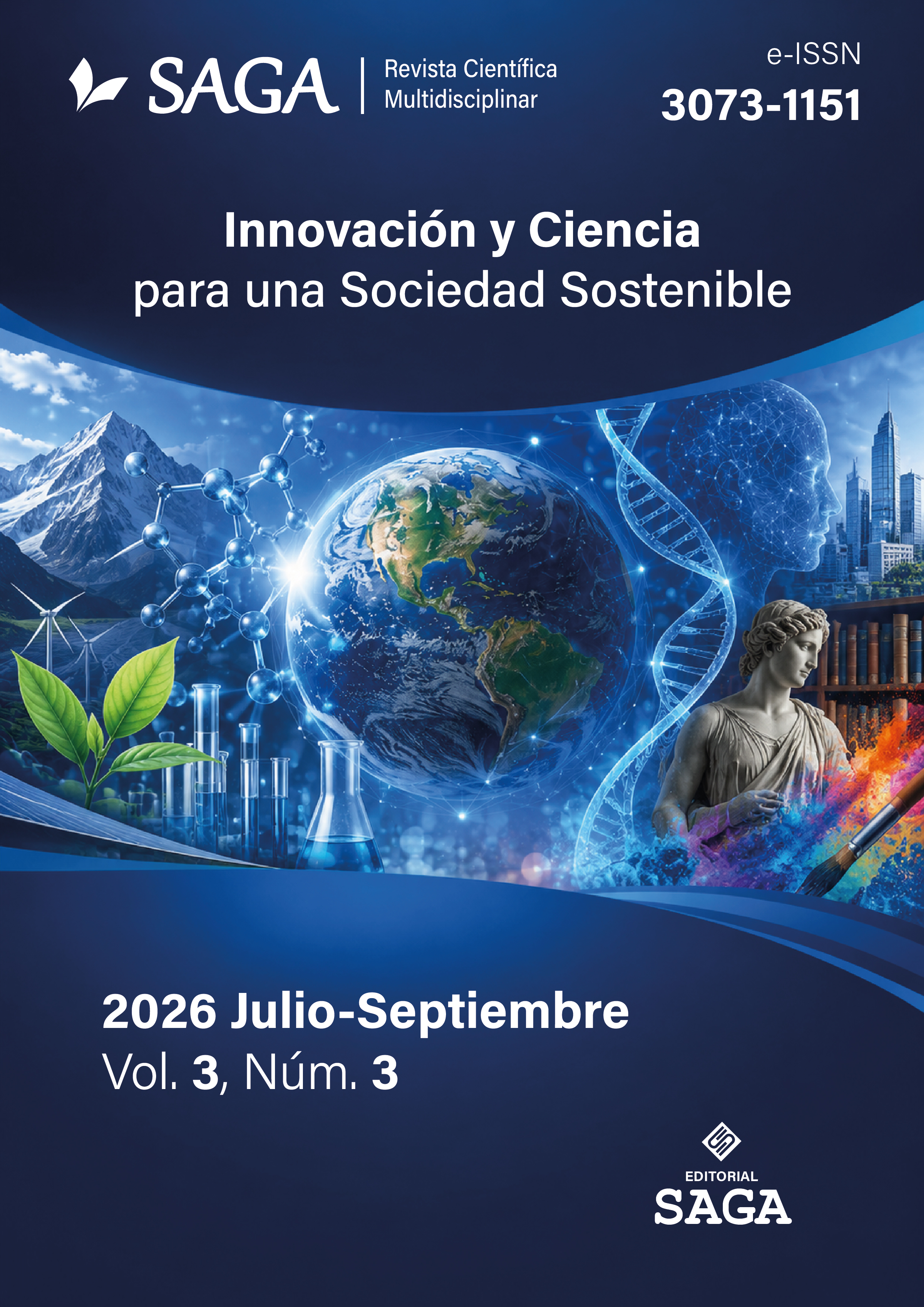
La Inteligencia Artificial y su relación en el rendimiento académico en estudiantes universitarios de Medicina
DOI:
https://doi.org/10.63415/saga.v3i3.410Palabras clave:
Inteligencia artificial, educación médica, rendimiento académico percibido, alfabetización en inteligencia artificialResumen
El presente estudio tuvo como objetivo analizar la relación entre el nivel de preparación en el uso de inteligencia artificial y el rendimiento académico percibido en estudiantes de Medicina de una universidad pública del sur del Ecuador. Se desarrolló bajo un enfoque cuantitativo, con diseño no experimental, de alcance correlacional y corte transversal. La población estuvo conformada por 581 estudiantes matriculados, de los cuales participaron 236, seleccionados mediante muestreo no probabilístico por conveniencia, superando el tamaño muestral previamente calculado. Se utilizaron dos instrumentos validados: la Escala de Preparación en Inteligencia Artificial para estudiantes de Medicina (MAIRS-MS) y la Escala de Rendimiento Académico Universitario (ERAU). El análisis se realizó mediante estadística descriptiva e inferencial, empleando el coeficiente de correlación Rho de Spearman. Los resultados evidenciaron predominio de niveles altos tanto en la Preparación en inteligencia artificial (56,3 %) como en el rendimiento académico percibido (59,7 %). Se identificó una correlación positiva, estadísticamente significativa y de magnitud moderada entre ambas variables (ρ = 0,382; p < 0,001). A nivel dimensional, las asociaciones más consistentes se observaron en cognición y habilidad, mientras que la relación con la organización de los recursos didácticos fue menor. Se concluye que la preparación en inteligencia artificial se relaciona con el rendimiento académico percibido, evidenciando su papel en el proceso de aprendizaje en educación médica.
Descargas
Referencias
Alkaissi, H., & McFarlane, S. I. (2023). Artificial Hallucinations in ChatGPT: Implications in Scientific Writing. Cureus. https://doi.org/10.7759/cureus.35179
AlZaabi, A., & Masters, K. (2025). Assessing medical students’ readiness for artificial intelligence after pre-clinical training. BMC Medical Education, 25(1), 824. https://doi.org/10.1186/s12909-025-07008-x
Alzarea, A. I., Ishaqui, A. A., Maqsood, M. B., Alanazi, A. S., Alsaidan, A. A., Mallhi, T. H., Kumar, N., Imran, M., Alshahrani, S. M., Alhassan, H. H., Alzarea, S. I., & Alsaidan, O. A. (2025). Evaluating AI performance in infectious disease education: A comparative analysis of ChatGPT, Google Bard, Perplexity AI, Microsoft Copilot, and Meta AI. Frontiers in Medicine, 12. https://doi.org/10.3389/fmed.2025.1679153
Asio, J. M. (2024). Artificial Intelligence (AI) Literacy and Academic Performance of Tertiary Level Students: A Preliminary Analysis. Social Sciences Humanities and Education Journal (SHE Journal), 5, 309-321. https://doi.org/10.25273/she.v5i2.20862
Chiu, T. K. F. (2025). AI literacy and competency: Definitions, frameworks, development and future research directions. Interactive Learning Environments, 33(5), 3225-3229. https://doi.org/10.1080/10494820.2025.2514372
Cochran, W. G. (1977). Sampling Techniques. Wiley.
Conover, W. J. (1971). Practical Nonparametric Statistics. Wiley.
Crompton, H., & Burke, D. (2023). Artificial intelligence in higher education: The state of the field | International Journal of Educational Technology in Higher Education | Springer Nature Link. Int J Educ Technol High Educ, 20(23). https://link.springer.com/article/10.1186/s41239-023-00392-8
Dong, L., Tang, X., & Wang, X. (2025). Examining the effect of artificial intelligence in relation to students’ academic achievement: A meta-analysis. Computers and Education: Artificial Intelligence, 8, 100400. https://doi.org/10.1016/j.caeai.2025.100400
Feigerlova, E., Hani, H., & Hothersall-Davies, E. (2025). A systematic review of the impact of artificial intelligence on educational outcomes in health professions education. BMC Medical Education, 25(1), 129. https://doi.org/10.1186/s12909-025-06719-5
Fengchun, M., & Wayne, H. (2023). Guidance for generative AI in education and research—UNESCO Biblioteca Digital. UNESCO. https://doi.org/https://doi.org/10.54675/EWZM9535
Giannakopoulos, K., Kavadella, A., Salim, A. A., Stamatopoulos, V., & Kaklamanos, E. G. (2023). Evaluation of the Performance of Generative AI Large Language Models ChatGPT, Google Bard, and Microsoft Bing Chat in Supporting Evidence-Based Dentistry: Comparative Mixed Methods Study. Journal of Medical Internet Research, 25(1), e51580. https://doi.org/10.2196/51580
Gilson, A., Safranek, C. W., Huang, T., Socrates, V., Chi, L., Taylor, R. A., & Chartash, D. (2023). How Does ChatGPT Perform on the United States Medical Licensing Examination (USMLE)? The Implications of Large Language Models for Medical Education and Knowledge Assessment. JMIR Medical Education, 9, e45312. https://doi.org/10.2196/45312
Karaca, O., Çalışkan, S. A., & Demir, K. (2021). Medical artificial intelligence readiness scale for medical students (MAIRS-MS) – development, validity and reliability study. BMC Medical Education, 21(1), 112. https://doi.org/10.1186/s12909-021-02546-6
Kasneci, E., Sessler, K., Küchemann, S., Bannert, M., Dementieva, D., Fischer, F., Gasser, U., Groh, G., Günnemann, S., Hüllermeier, E., Krusche, S., Kutyniok, G., Michaeli, T., Nerdel, C., Pfeffer, J., Poquet, O., Sailer, M., Schmidt, A., Seidel, T., … Kasneci, G. (2023). ChatGPT for good? On opportunities and challenges of large language models for education. Learning and Individual Differences, 103, 102274. https://doi.org/10.1016/j.lindif.2023.102274
Kung, T. H., Cheatham, M., Medenilla, A., Sillos, C., Leon, L. D., Elepaño, C., Madriaga, M., Aggabao, R., Diaz-Candido, G., Maningo, J., & Tseng, V. (2023). Performance of ChatGPT on USMLE: Potential for AI-assisted medical education using large language models. PLOS Digital Health, 2(2), e0000198. https://doi.org/10.1371/journal.pdig.0000198
Lim, W. M., Gunasekara, A., Pallant, J. L., Pallant, J. I., & Pechenkina, E. (2023). Generative AI and the future of education: Ragnarök or reformation? A paradoxical perspective from management educators. The International Journal of Management Education, 21(2), 100790. https://doi.org/10.1016/j.ijme.2023.100790
Luong, J., Tzang, C.-C., McWatt, S., Brassett, C., Stearns, D., Sagoo, M. G., Kunzel, C., Sakurai, T., Chien, C.-L., Noel, G., & Wu, A. (2025). Exploring Artificial Intelligence Readiness in Medical Students: Analysis of a Global Survey. Medical Science Educator, 35(1), 331-341. https://doi.org/10.1007/s40670-024-02190-x
Maaß, L., Grab-Kroll, C., Koerner, J., Öchsner, W., Schön, M., Messerer, D., Böckers, T., & Böckers, A. (2025). Artificial Intelligence and ChatGPT in Medical Education: A Cross-Sectional Questionnaire on students’ Competence. Journal of CME, 14(1), 2437293. https://doi.org/10.1080/28338073.2024.2437293
Mohd Razali, N., & Yap, B. (2011). Power Comparisons of Shapiro-Wilk, Kolmogorov-Smirnov, Lilliefors and Anderson-Darling Tests. J. Stat. Model. Analytics, 2.
Ng, D. T. K., Leung, J. K. L., Chu, K. W. S., & Qiao, M. S. (2021). AI Literacy: Definition, Teaching, Evaluation and Ethical Issues. Proceedings of the Association for Information Science and Technology, 58(1), 504-509. https://doi.org/10.1002/pra2.487
Nikolopoulou, K. (2024). Generative Artificial Intelligence in Higher Education: Exploring Ways of Harnessing Pedagogical Practices with the Assistance of ChatGPT. International Journal of Changes in Education, 1(2), 103-111. https://doi.org/10.47852/bonviewIJCE42022489
Presentamos ChatGPT. (2024, marzo 13). OpenAI. https://openai.com/es-419/index/chatgpt/
Remaycuna-Vásquez, A., Carrión-Barco, G., Espinoza-Porras, F. R., & Niño, G. L. E. M. (2023). Validez y confiabilidad de la escala de rendimiento académico desde la percepción del alumno. Revista de Ciencias Sociales, 29, 197-209. https://doi.org/10.31876/rcs.v29i.40458
Rudolph, J., Tan, S., & Tan, S. (2023). ChatGPT: Bullshit spewer or the end of traditional assessments in higher education? Journal of Applied Learning & Teaching, 6(1), 342-363. https://doi.org/https://doi.org/10.37074/jalt.2023.6.1.9
Sallam, M. (2023). ChatGPT Utility in Healthcare Education, Research, and Practice: Systematic Review on the Promising Perspectives and Valid Concerns. Healthcare, 11(6), 887. https://doi.org/10.3390/healthcare11060887
SHAPIRO, S. S., & WILK, M. B. (1965). An analysis of variance test for normality (complete samples). Biometrika, 52(3-4), 591-611. https://doi.org/10.1093/biomet/52.3-4.591
Singhal, K., Azizi, S., Tu, T., Mahdavi, S. S., Wei, J., Chung, H. W., Scales, N., Tanwani, A., Cole-Lewis, H., Pfohl, S., Payne, P., Seneviratne, M., Gamble, P., Kelly, C., Babiker, A., Schärli, N., Chowdhery, A., Mansfield, P., Demner-Fushman, D., … Natarajan, V. (2023). Large language models encode clinical knowledge. Nature, 620(7972), 172-180. https://doi.org/10.1038/s41586-023-06291-2
Spearman, C. (1904). The Proof and Measurement of Association between Two Things. The American Journal of Psychology, 15(1), 72-101. https://doi.org/10.2307/1412159
Wang, J., & Fan, W. (2025). RETRACTED ARTICLE: The effect of ChatGPT on students’ learning performance, learning perception, and higher-order thinking: insights from a meta-analysis. Humanities and Social Sciences Communications, 12(1), 621. https://doi.org/10.1057/s41599-025-04787-y
Wang, S., Wang, F., Zhu, Z., Wang, J., Tran, T., & Du, Z. (2024). Artificial intelligence in education: A systematic literature review. Expert Systems with Applications, 252, 124167. https://doi.org/10.1016/j.eswa.2024.124167
Zhai, X., Chu, X., Chai, C. S., Jong, M. S. Y., Istenic, A., Spector, M., Liu, J.-B., Yuan, J., & Li, Y. (2021). A Review of Artificial Intelligence (AI) in Education from 2010 to 2020. Complexity, 2021(1), 8812542. https://doi.org/10.1155/2021/8812542
Zhang, J., Yoon, C., & Pinkas, A. (s. f.). Exploring the Usage of ChatGPT Among Medical Students in the United States. https://doi.org/10.1177/23821205241264695
Zhang, K., & Aslan, A. B. (2021). AI technologies for education: Recent research & future directions. Computers and Education: Artificial Intelligence, 2, 100025. https://doi.org/10.1016/j.caeai.2021.100025
Ziapour, A., Darabi, F., Janjani, P., Amani, M. A., Yıldırım, M., & Motevaseli, S. (2025). Factors affecting medical artificial intelligence (AI) readiness among medical students: Taking stock and looking forward. BMC Medical Education, 25(1), 264. https://doi.org/10.1186/s12909-025-06852-1
Publicado
Número
Sección
Licencia
Derechos de autor 2026 Josué Chamba León, Jorge Vivanco-Roman (Autor/a)

Esta obra está bajo una licencia internacional Creative Commons Atribución-NoComercial 4.0.
















 Av. Carlos Plaza Dañin y Av. Miguel H. Alcivar, Guayaquil, Ecuador
 editor@revistasaga.org
 +593962679148